

When it comes to money, every Indian dreams of one thing — to make it grow safely. Whether it’s saving for the future, your kids, or that small dream of buying a car or house, the path usually starts with the right investment plan.
But the problem is, with hundreds of options and too many so-called “experts” online, most people end up confused. Should you choose mutual funds or a fixed deposit? SIP or stock? PPF or NPS? There’s so much noise that beginners often don’t even start.
So in this article, let’s talk honestly and simply — about the best investment plans in India for 2025 that are safe, profitable, and easy to understand.
We’re not here to confuse you with complex charts or formulas, just plain English that even a college student or homemaker can relate to.

Why You Should Start Investing in 2025
2025 is shaping up to be a special year for Indian investors. The economy is growing fast, inflation is moderate, and digital platforms have made investing easier than ever. You can literally open an app, tap a few buttons, and start your investment journey in minutes.
But the real reason to invest is simple — your money loses value if it just sleeps in the bank.
If you’re keeping ₹1 lakh in your savings account, and inflation is 6%, you’re actually losing ₹6,000 worth of value every year. That’s like throwing away free money.
When you invest, you let your money work for you. It grows, it compounds, and it helps you reach your goals faster. Even small investments — ₹500 or ₹1000 a month — can grow into big amounts over time if you stay consistent.
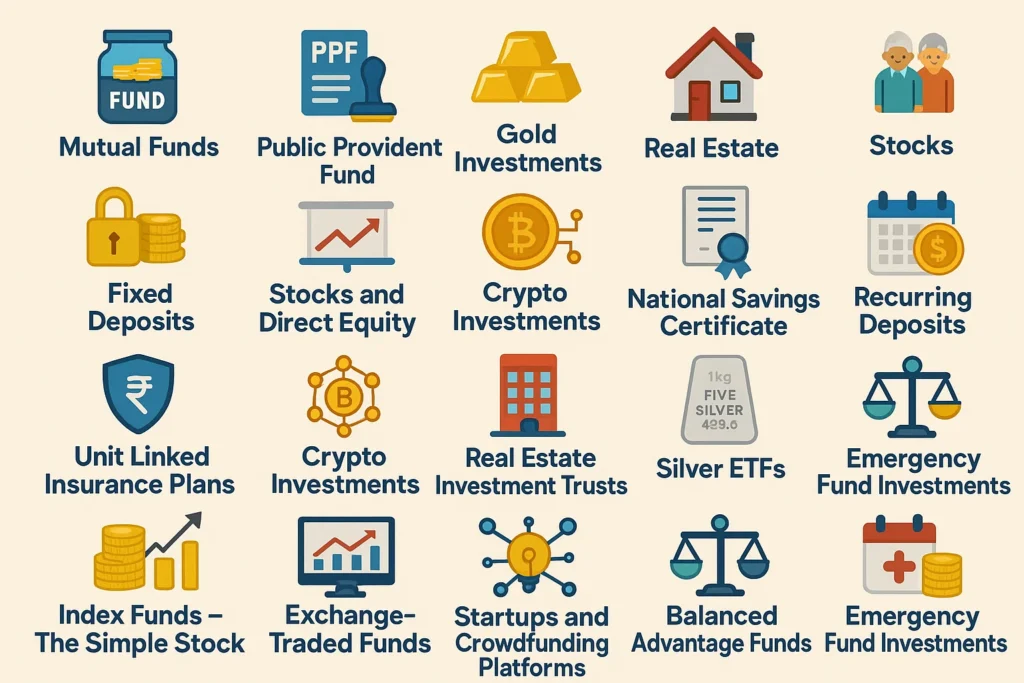
1. Mutual Funds (Especially SIPs)
Let’s start with the most popular and beginner-friendly option — mutual funds.
In simple terms, mutual funds collect money from thousands of people and invest it into different companies’ shares, bonds, or assets. When the companies grow, your investment grows too.
The easiest way to start is through SIP (Systematic Investment Plan).
You just invest a small fixed amount every month — say ₹1000 or ₹2000 — and the app automatically buys mutual fund units for you.
Over time, because of compounding, your small monthly investment turns into a big fund.
Let’s say you invest ₹2000 per month for 10 years at an average 12% return — you’ll end up with around ₹4.5 lakhs.
The best part? You don’t need to time the market or be an expert. SIP takes care of ups and downs automatically.
A few good mutual fund types to look at:
- Large Cap Funds: Safe, stable, good for beginners.
- Flexi Cap Funds: Adjust automatically between big and mid companies.
- ELSS Funds: Give you tax benefits under Section 80C.
2. Public Provident Fund (PPF)
Ah, the good old PPF — still one of the safest and most trusted investment plans for Indians.
PPF is a government-backed scheme that gives you around 7–8% interest, completely tax-free.
It’s perfect for people who want long-term safety and don’t want to take risks.
You can start a PPF account with just ₹500, and the maximum limit is ₹1.5 lakh per year.
The lock-in period is 15 years, but you can withdraw partially after 7 years if needed.
Think of PPF as your retirement money machine. You can’t touch it easily, but it quietly grows behind the scenes.
3. National Pension System (NPS)
If you want to secure your future and save on taxes, NPS is an excellent option.
It’s a government scheme where you invest regularly till your retirement, and after that, you get a steady income (pension).
The returns are higher than PPF (around 9–12% depending on the market), and it’s flexible too.
You can choose how your money is invested — in equity, corporate bonds, or government funds.
Another benefit is tax savings — you can claim deductions up to ₹50,000 under Section 80CCD(1B).
For young people in their 20s and 30s, NPS is a smart way to start early and retire stress-free.
4. Fixed Deposits (FDs)
FDs are old-fashioned but still reliable.
They’re great for people who don’t like market risk. You deposit a fixed amount for a fixed time, and the bank gives you a guaranteed return — usually between 6% and 7.5%.
But remember — the returns are taxable, so they don’t beat inflation easily.
Still, it’s a good short-term or emergency option.
For example, if you invest ₹2 lakh in a 1-year FD at 7%, you’ll get ₹14,000 interest. Not huge, but safe.
Pro tip: Use FDs for emergency funds, not long-term goals.
5. Gold Investments (Digital Gold or ETFs)
Gold is emotion for Indians — and also a great inflation shield.
But instead of keeping jewelry in lockers, go for digital gold, Sovereign Gold Bonds (SGB), or Gold ETFs.
Digital gold lets you buy as little as ₹100 worth of gold online. SGBs are even better — they give around 2.5% interest plus the rise in gold price.
It’s one of those “sleep peacefully” investments — you don’t need to monitor it daily, and it still grows.
6. Real Estate
Real estate is another evergreen investment. Buying property might be costly, but even a small plot in the right area can multiply in value over a few years.
However, it’s not for short-term goals. You need patience.
If you can’t afford property now, you can look at REITs (Real Estate Investment Trusts) — they let you invest in real estate through mutual fund-style platforms.
It’s like owning a small piece of a mall or office building — cool, right?
7. Stocks and Direct Equity
Okay, this one’s risky but also powerful. Stocks can make you rich if you learn slowly and stay consistent.
Don’t try to gamble or trade daily. Instead, focus on good quality companies — the kind you use in your daily life: banks, telecom, FMCG brands, etc.
Start small — maybe ₹1000 or ₹2000 in one or two companies — and learn as you go.
Use apps like Groww, Zerodha, or Upstox to buy shares easily.
Long-term stock investing can beat every other form of investment, but only if you have patience and emotional control.
8. Corporate Bonds and Government Securities
If you want something safer than stocks but a little more rewarding than fixed deposits, corporate bonds and government securities (G-Secs) are smart picks.
In simple words, when you buy a bond, you’re lending your money to a company or the government for a fixed time, and they pay you interest.
The interest rate is usually between 7% and 10%, depending on risk and duration.
Government bonds are super safe — almost zero chance of loss. Corporate bonds give more return but with a little risk.
The best part? Nowadays, you don’t need to be a big investor. You can buy bonds online with apps like Zerodha or RBI Retail Direct.
If you’re someone who wants regular, stable income — bonds can be your peaceful night’s sleep.
9. Recurring Deposits (RDs)
Small savers love RDs. It’s like a simple version of SIP — you deposit a small fixed amount every month, and after a year or two, you get your money back with interest.
Banks usually offer around 6–7% on RDs. It’s not huge, but it helps build discipline.
It’s great for people who don’t have large lump sums to invest. Like students, homemakers, or small business owners — it teaches you to save consistently.
Think of it as your “habit-builder” investment. Once you’re regular with RDs, you can easily move to SIPs later.
10. Unit Linked Insurance Plans (ULIPs)
ULIPs are a mix of insurance and investment. A part of your money goes to life cover, and the rest is invested in market-linked funds.
They got a bad name earlier for high charges, but the newer ULIPs (especially online ones) are much better and more transparent.
The returns depend on market performance — generally between 8–12%.
Plus, you get tax benefits under Section 80C.
If you want both life cover and long-term growth, ULIPs can be a decent option. Just make sure you read the terms carefully and hold them for at least 5 years.
11. Post Office Saving Schemes
Post office investments are old-school but still loved in smaller towns.
They are safe, government-backed, and give good returns.
Some of the best post office schemes are:
- Senior Citizen Savings Scheme (SCSS) – around 8.2% interest
- Monthly Income Scheme (MIS) – monthly payouts
- National Savings Certificate (NSC) – 5-year lock-in with steady growth
These schemes are perfect for people who don’t want online apps or market risk. The trust factor of India Post is still unbeatable in rural areas.
12. Crypto Investments (for Risk Takers)
Now, let’s talk about something bold — cryptocurrency.
It’s risky, unpredictable, and not officially regulated in India yet, but it’s also one of the most exciting asset classes in the world.
If you ever invest in crypto, treat it like “fun money” — not your main savings. Maybe 2–5% of your total portfolio.
Stick with top coins like Bitcoin, Ethereum, or Solana. Avoid shady tokens or “get rich quick” coins.
Crypto can give crazy returns — but it can also fall overnight. So be careful, research properly, and only invest what you can afford to lose.
13. National Savings Certificate (NSC)
Yes, I mentioned it briefly under post office schemes, but NSC deserves its own spotlight.
It’s one of India’s oldest and most trusted savings plans. You invest for 5 years, get a fixed interest rate (around 7.7% now), and it’s eligible for tax deductions under Section 80C.
The interest is compounded yearly but paid at the end, so it quietly grows in the background.
It’s like planting a money seed and forgetting it — when you check later, it’s grown into a small tree.
14. Index Funds – The Simple Stock Option
If you want to invest in the stock market but don’t want the headache of picking companies, index funds are perfect.
They simply track the top companies in the market — like Nifty 50 or Sensex — and mirror their performance.
So if India’s top companies grow, you grow too.
The risk is lower than direct stocks, and the returns over the long term are excellent (10–12% on average).
You can start an SIP in index funds through any mutual fund app.
Warren Buffett, the world’s richest investor, has said multiple times that most people should just invest in index funds and relax — and he’s right.
15. Real Estate Investment Trusts (REITs)
For people who can’t buy full properties, REITs are a game changer.
They allow you to invest in real estate (like offices, malls, hotels) through stock exchanges.
You earn returns through rent and property appreciation. It’s like being a part-owner of a big commercial building without having to buy or maintain it.
The returns can be around 8–10% annually.
They’re also liquid, meaning you can sell them easily if you need money — unlike real property, which can take months.
16. Silver ETFs – The Hidden Gem
Everyone talks about gold, but silver is silently gaining attention.
Silver ETFs (Exchange Traded Funds) are easy ways to invest in silver without storing it physically.
Why silver? Because it’s not only a precious metal — it’s also used in electronics, EV batteries, and solar panels. As demand rises globally, silver prices are expected to climb.
Adding a bit of silver to your portfolio can be a smart hedge against inflation.
17. Startups and Crowdfunding Platforms
This is for people who like taking calculated risks.
Today, you can invest small amounts in startups through online platforms like Tyke or Grip Invest.
These platforms let you own a fraction of a business or lend to small companies and earn returns as they grow.
It’s risky, yes, but if one or two startups perform well, your returns can be massive.
Only invest what you can afford to lose — but it’s a modern and exciting way to diversify.
18. Exchange-Traded Funds (ETFs)
ETFs are like a mix of mutual funds and shares.
They’re easy to buy, transparent, and often cheaper because of low fees.
You can buy ETFs that track gold, stocks, or even international markets. They’re great for people who want diversification in one go.
ETFs are slowly becoming more popular among young investors who prefer flexibility and control over their money.
19. Balanced Advantage Funds (BAFs)
These are hybrid funds that adjust automatically between equity and debt based on market conditions.
When markets go up, they shift to debt; when markets fall, they buy more equity — smart, right?
They offer stability, decent returns (around 10%), and less tension during market crashes.
For beginners who want moderate risk and peace of mind, BAFs are perfect.
20. Emergency Fund Investments
Finally, every investor — beginner or expert — needs an emergency fund.
This isn’t about earning; it’s about safety.
Keep at least 3–6 months’ expenses in a liquid fund, savings account, or short-term FD.
It helps you during medical emergencies, job loss, or sudden expenses — without touching your main investments.
Think of it as your financial seatbelt. You don’t notice it every day, but it saves your life when things go wrong.
Final Thoughts
There’s no single “best” investment plan. The right one depends on your goals, age, income, and risk comfort.
Some people prefer safety, others want growth — and both are fine.
The real trick is to start early, stay consistent, and never stop learning.
Even ₹500 a month invested wisely can turn into lakhs with time.
2025 is a great time to begin. The Indian economy is booming, digital apps make investing simple, and awareness is higher than ever.
Don’t wait for “the right time.” The best time to invest was yesterday. The next best time — is today.